

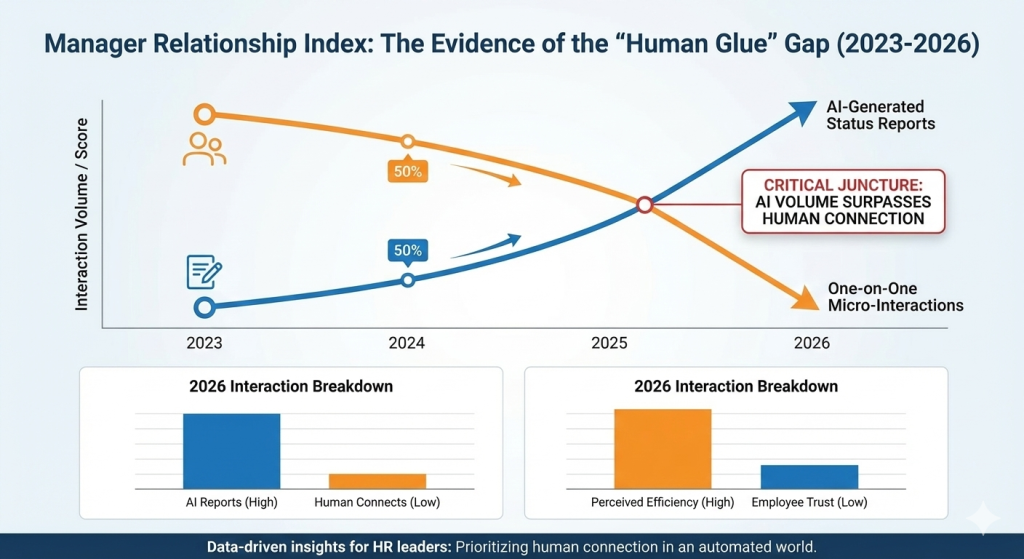
For three years, we told middle managers to “do more with less” while we flooded their dashboards with AI-driven productivity insights. We promised them that automation would “free them up for strategic work.” Instead, it has hollowed out the middle.
In early 2026, we are witnessing a Manager Liquidity Crisis. While organizations have plenty of “data liquidity”—real-time stats on every click and keystroke—they are running dry on the “human glue” that holds teams together during the rapid-fire pivots of the AI era.
The Automation Paradox: High Efficiency, Zero Connection
The push for efficiency in 2025 led to the mass automation of “low-value” managerial tasks: scheduling, status reporting, and basic performance tracking. On paper, this was a win. In reality, it removed the natural “micro-interactions” that allowed managers to gauge team morale.
Today’s managers are left with a calendar that contains only the “hard stuff”—high-stakes conflict, mental health crises, and complex cross-functional friction. Without the low-stakes check-ins to build credit in the “relationship bank,” managers are struggling to lead. They aren’t just burnt out; they are context-starved.
From Burnout to “Boreout”
While we spent years fighting burnout, 2026 has introduced a new antagonist: Boreout. As AI agents take over the technical heavy lifting, many mid-to-senior employees are experiencing a “loss of aliveness.” They are completing their tasks efficiently but feel psychologically “un-met” by their roles.
- The Risk: High-performers are staying in roles they have outgrown because the “automated” nature of the work makes it easy to hide.
- The Impact: Quiet compliance is replacing active innovation. If your employees feel like they are just “prompt engineers” for a machine they don’t own, their institutional loyalty evaporates.
🚩 Manager’s Checklist: 2026 Boreout Red Flags
If your team is hitting their KPIs but losing their “edge,” look for these three subtle signs of disengagement:

The “Silent Closer”
High task completion and perfect metrics, but zero participation in optional brainstorms or “blue-sky” sessions. They are doing the work, but they’ve stopped caring about the future of the work.
The “Autopilot” Specialist
A sudden reluctance to experiment with new AI features or workflow automations. They prefer staying in a manual “safe zone” because learning new tools requires a psychological investment they are no longer willing to make.
The “Digital Ghost”
Minimal camera or voice usage in collaborative sessions. If an employee who was once vocal now defaults to “chat only” or remains a black tile on screen, they are likely suffering from a lack of “presence liquidity.”